







When you're hauling heavy equipment across Edmonton or towing a fifth-wheel trailer to the mountains, understanding your truck's capabilities isn't just helpful—it's essential. At City Ford in Edmonton, we help drivers match their towing needs with the right Super Duty configuration every day.
The 2026 Ford Super Duty lineup delivers best-in-class towing capacity of up to 40,000 pounds when properly equipped with the 6.7L High Output Power Stroke diesel engine. Whether you're choosing between the F-250, F-350, or F-450, each model offers distinct payload and towing capabilities designed for different work demands. Our team at City Ford has put together this comprehensive guide to help you understand exactly what these trucks can handle and which configuration matches your requirements.
Key Highlight
The 2026 Ford F-350 Super Duty achieves a maximum conventional towing capacity exceeding 22,500 pounds and gooseneck towing capacity of 38,600 pounds with the standard-output 6.7L Power Stroke diesel—numbers that put it at the top of the heavy-duty truck segment.
This guide covers the Ford Super Duty towing capacity across all engine options, explains how different configurations affect your payload limits, and provides practical advice for maximizing your truck's capabilities. We'll break down the differences between conventional, fifth-wheel, and gooseneck towing, examine how cab and bed configurations impact ratings, and share what Edmonton drivers should consider when selecting their Super Duty setup.
Key Takeaways
- The 2026 Ford Super Duty offers maximum gooseneck towing capacity of 40,000 pounds with the 6.7L High Output Power Stroke diesel engine
- Best-in-class payload capacity reaches 8,000 pounds when equipped with the 6.8L V8 gasoline engine
- Engine choice significantly impacts towing capacity—diesel engines provide 38,600-40,000 lbs gooseneck capacity while gasoline engines range from 18,900-22,500 lbs
- Fifth-wheel and gooseneck configurations distribute weight over the rear axle more effectively than conventional towing, enabling higher capacity ratings
- City Ford in Edmonton stocks multiple Super Duty configurations and our team can help you select the right setup for your specific towing needs—call 780-454-2000
Understanding Ford Super Duty Towing Capacity by Model
The Ford Super Duty family includes three distinct models—F-250, F-350, and F-450—each engineered for progressively higher gross vehicle weight ratings (GVWR) and towing capabilities. The F-250 serves as the entry point to heavy-duty towing, while the F-350 and F-450 support increasingly demanding commercial and recreational applications. At City Ford, we find that most Edmonton drivers choosing a Super Duty are deciding between the F-250 and F-350, with the F-450 reserved for specialized commercial use.
Maximum towing capacity depends on several interconnected factors: engine selection, drivetrain configuration (4x2 versus 4x4), axle ratio, cab style, and bed length. A properly equipped F-350 with the 6.7L High Output diesel can tow up to 40,000 pounds using a gooseneck hitch, while the same model with a gasoline engine tops out around 22,500 pounds for conventional towing. These aren't just theoretical numbers—they represent real-world capabilities that our customers use daily for construction equipment transport, livestock hauling, and RV towing.
F-250 Super Duty
Maximum conventional towing up to 20,000 lbs with diesel engines. Ideal for medium-duty work trucks and travel trailers under 15,000 lbs.
F-350 Super Duty
Maximum gooseneck towing up to 40,000 lbs with High Output diesel. The most versatile choice for heavy fifth-wheel RVs and commercial trailers.
F-450 Super Duty
Highest GVWR ratings with dual rear wheels standard. Designed for commercial upfitting and maximum payload applications.
The distinction between these models extends beyond just towing numbers. The F-350 offers both single rear wheel (SRW) and dual rear wheel (DRW) configurations, with the DRW setup providing enhanced stability under heavy trailer loads. The F-450 comes exclusively with dual rear wheels and a reinforced chassis designed for commercial body upfitting. When you visit our showroom at 14750 Mark Messier Trail in Edmonton, our product specialists can walk you through the specific configurations we have in stock and help you understand which model aligns with your intended use.
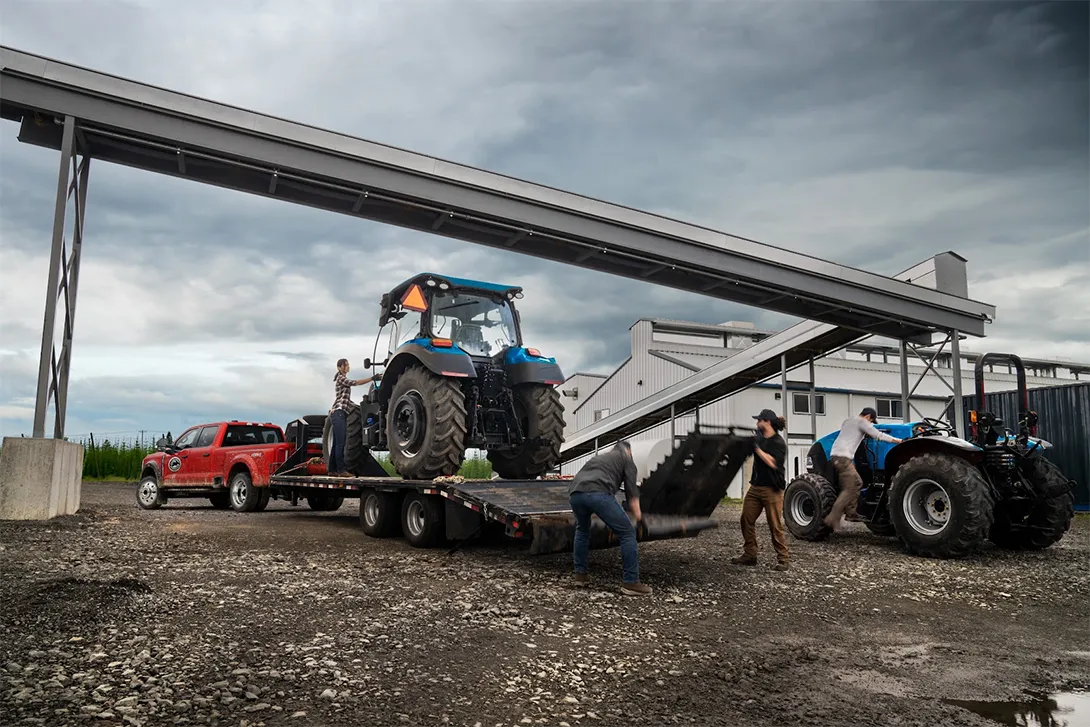
The 2026 Ford F-350 Super Duty equipped with fifth-wheel hitch prep package, demonstrating the truck's capability for heavy recreational and commercial towing applications
Ford Super Duty Towing Capacity by Engine Type
Engine selection represents the single most significant factor affecting your Super Duty's towing capacity. The 2026 model year offers four distinct powerplants, each with different torque characteristics, fuel efficiency profiles, and maximum towing ratings. Understanding these differences helps you balance initial cost, operating expenses, and capability requirements.
| Engine | Max Conventional Towing | Max Gooseneck Towing | Max Payload |
|---|---|---|---|
| 6.8L V8 Gas | 18,900 lbs | Not specified | 8,000 lbs |
| 7.3L V8 Gas | 22,500 lbs | Not specified | 7,635 lbs |
| 6.7L Power Stroke Diesel | 22,500+ lbs | 38,600 lbs | 6,952 lbs |
| 6.7L HO Power Stroke Diesel | 22,500+ lbs | 40,000 lbs | 6,935 lbs |
Diesel Engine Advantages for Heavy Towing
The 6.7L Power Stroke diesel engines deliver substantially higher torque output compared to gasoline alternatives, which translates directly to superior towing performance. The standard-output version produces 475 horsepower at 2,600 rpm, while the High Output variant increases power delivery for maximum capability. Both diesel options include integrated exhaust braking, which assists with speed control during downhill towing—a feature Edmonton drivers particularly appreciate when hauling through the Rocky Mountain foothills.
Diesel engines also provide better fuel efficiency under load, though they carry a higher initial purchase price and require diesel exhaust fluid (DEF) for emissions compliance. The 410-amp dual alternator system (250-amp plus 160-amp) comes standard with diesel configurations, supporting auxiliary equipment and trailer brake controllers without taxing the electrical system. Our service department at City Ford stocks DEF and can handle all diesel-specific maintenance requirements.
Gasoline Engine Considerations
The 7.3L V8 gasoline engine represents Ford's largest-displacement gas powerplant and delivers impressive towing capacity up to 22,500 pounds for conventional applications. This engine pairs with a 10-speed automatic transmission and offers lower upfront costs compared to diesel options. The 6.8L V8 provides the highest payload rating at 8,000 pounds, making it ideal for trucks that prioritize bed capacity over maximum trailer weight. Both gasoline engines eliminate DEF requirements and typically cost less for routine maintenance, though fuel consumption increases notably under heavy loads.
What Edmonton Drivers Should Know About Towing Configurations
The method you use to connect your trailer significantly impacts both maximum capacity and towing stability. The Super Duty supports three primary towing configurations: conventional (bumper-mounted), fifth-wheel, and gooseneck. Each system distributes trailer weight differently and serves distinct applications. Understanding these differences helps you select the right hitch setup and avoid exceeding your truck's rated capacity.
Conventional Towing with Receiver Hitches
Conventional towing uses a rear bumper or frame-mounted receiver hitch, with the trailer tongue applying 10-15 percent of total trailer weight directly to the hitch ball. This configuration works well for lighter trailers, equipment haulers, and travel trailers under 15,000 pounds. Maximum conventional towing capacity for the Super Duty ranges from 18,900 pounds (6.8L gas) to over 22,500 pounds (diesel engines), depending on configuration. The integrated trailer brake controller and Trailer Sway Control system help maintain stability, though conventional hitches create more leverage on the rear suspension compared to bed-mounted systems.
Fifth-Wheel and Gooseneck Towing
Fifth-wheel and gooseneck hitches mount in the truck bed, positioning the hitch point directly over the rear axle. This arrangement distributes trailer tongue weight more effectively and enables substantially higher capacity ratings—up to 40,000 pounds with proper equipment. The fifth-wheel/gooseneck prep package includes five bed attachment points with plugs, frame-mounted cross members, and an integrated seven-pin connector on the driver's side bed wall. Edmonton drivers towing large fifth-wheel RVs or commercial gooseneck trailers typically require these systems for both capacity and stability advantages.
One critical consideration: shorter bed configurations (6.75-foot beds) provide less clearance between the cab and trailer during tight turns compared to 8-foot beds. When selecting a trailer and tow vehicle combination, you must ensure adequate clearance for 90-degree turns typical during low-speed parking maneuvers. Insufficient clearance can result in trailer-to-cab contact and damage to both vehicles. Our team at City Ford can help you evaluate bed length requirements based on your specific trailer dimensions—call us at 780-454-2000 to discuss your setup.
Payload Capacity and Its Relationship to Towing
Payload capacity and towing capacity are related but distinct specifications that work together to define your truck's total capability. Payload includes everything you place in or on the truck: cargo in the bed, passengers in the cab, aftermarket accessories, and critically, trailer tongue weight. Many drivers focus exclusively on maximum towing numbers while overlooking payload limitations, which can lead to exceeding the truck's rated capacity even when trailer weight remains within limits.
How Tongue Weight Affects Payload
When towing conventionally, trailer tongue weight typically represents 10-15 percent of total trailer weight and counts directly against your payload capacity. For example, a 15,000-pound travel trailer applies approximately 1,500-2,250 pounds of tongue weight to your hitch. If your truck's payload capacity is 3,000 pounds and you're carrying 500 pounds of cargo plus 400 pounds of passengers, you've already consumed 900 pounds of capacity before accounting for tongue weight. Adding the 2,000-pound tongue load would exceed your payload rating by 900 pounds, even though the 15,000-pound trailer remains well within the truck's 22,500-pound towing capacity.
Fifth-wheel and gooseneck trailers apply higher vertical loads—typically 20-25 percent of trailer weight—directly over the rear axle. A 30,000-pound fifth-wheel RV creates 6,000-7,500 pounds of pin weight, which must fit within your truck's payload capacity along with all other cargo and passengers. The F-350 with diesel engines offers payload capacity around 6,935-6,952 pounds, while gasoline configurations provide up to 8,000 pounds. These numbers explain why payload capacity often becomes the limiting factor for heavy fifth-wheel towing, not maximum towing capacity.
Calculating Your Actual Available Capacity
To determine your actual available towing capacity, start with your truck's payload rating (found on the door jamb sticker) and subtract the weight of all occupants, cargo, aftermarket accessories, and any equipment in the bed. The remaining payload capacity represents your maximum allowable tongue or pin weight. Multiply this number by the appropriate factor (6.67 for conventional towing at 15% tongue weight, or 4-5 for fifth-wheel towing at 20-25% pin weight) to find your practical maximum trailer weight. This calculation often yields a lower number than the truck's advertised maximum towing capacity, but it ensures you remain within all rated limits.
| Configuration | Payload Capacity | Typical Tongue Weight % | Practical Max Trailer Weight |
|---|---|---|---|
| F-350 SRW, 6.8L Gas | 8,000 lbs | 15% (conventional) | ~18,900 lbs |
| F-350 SRW, 7.3L Gas | 7,635 lbs | 15% (conventional) | ~22,500 lbs |
| F-350 SRW, 6.7L Diesel | 6,952 lbs | 20-25% (fifth-wheel) | ~27,800-34,750 lbs |
| F-350 DRW, 6.7L HO Diesel | 6,935 lbs | 20-25% (gooseneck) | ~27,700-34,675 lbs |
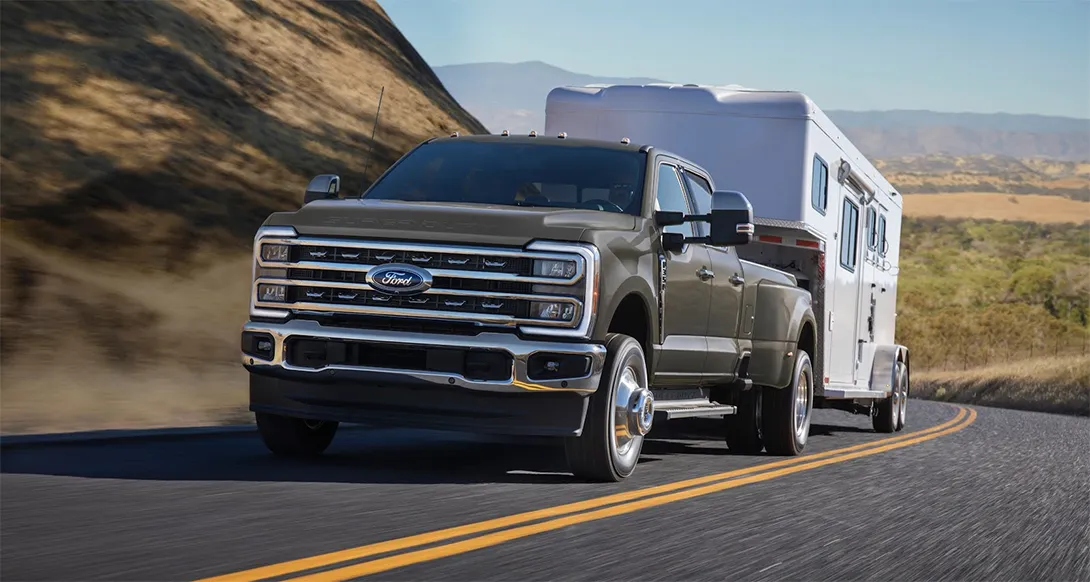
The fully-boxed high-strength steel frame and heavy-duty suspension system that enable the Super Duty's best-in-class towing and payload capabilities
Maximizing Your Ford Super Duty Towing Capacity in Edmonton
Achieving maximum towing capacity requires more than just selecting the right engine—it involves choosing the optimal combination of drivetrain, axle ratio, cab configuration, and bed length for your specific needs. Several factors work together to determine your truck's final towing rating, and understanding these variables helps you configure a Super Duty that matches your requirements without paying for unnecessary capability.
Axle Ratio Selection
Axle ratio determines the number of driveshaft rotations required to turn the rear wheels one complete revolution. Lower numerical ratios (like 3.31:1) provide better fuel efficiency for highway driving, while higher ratios (like 3.55:1 or available 4.30:1) multiply engine torque for improved towing performance. The electronic-locking rear differential with 3.55 axle ratio represents the most common choice for heavy towing applications, balancing capability with reasonable fuel economy. Higher ratios increase towing capacity but reduce highway fuel efficiency—a trade-off Edmonton drivers should consider based on their typical driving patterns.
Drivetrain Configuration Impact
Four-wheel drive (4x4) adds a transfer case, front differential, and additional driveline components that increase vehicle weight by approximately 400-500 pounds compared to rear-wheel drive (4x2) configurations. This added weight slightly reduces maximum towing capacity and payload ratings, though the difference typically amounts to only 200-400 pounds depending on configuration. For Edmonton drivers who need winter traction or off-road capability, the 4x4 system's benefits usually outweigh the minor capacity reduction. However, if you're maximizing towing capacity for on-road use only, a 4x2 configuration provides slightly higher ratings.
| Factor | Impact on Towing Capacity | Recommendation |
|---|---|---|
| Crew Cab vs. Regular Cab | Crew cab adds ~400-600 lbs, reducing capacity | Choose based on passenger needs; capacity difference is minimal |
| 8-foot vs. 6.75-foot Bed | Longer bed adds weight but improves fifth-wheel clearance | 8-foot bed recommended for large fifth-wheels |
| 4x4 vs. 4x2 | 4x4 reduces capacity by ~200-400 lbs | Choose 4x4 for winter/off-road; 4x2 for max capacity |
| SRW vs. DRW (F-350) | DRW increases GVWR and stability | DRW for commercial use or heaviest trailers |
Essential Towing Features and Packages
The Super Duty includes several integrated technologies that enhance towing safety and convenience. Pro Trailer Backup Assist simplifies low-speed trailer maneuvering by allowing you to control trailer direction using a knob on the dashboard—the truck automatically steers to achieve the desired trailer path. The Blind Spot Information System extends coverage along the length of your trailer when properly configured, alerting you to vehicles in adjacent lanes. Trailer Sway Control monitors trailer movement and applies selective braking with engine torque reduction if sway is detected, helping maintain control in crosswinds or emergency maneuvers.
The available Lariat Premium Package adds several advanced towing features including Pro Trailer Hitch Assist (which provides visual guidance for hitch alignment), adaptive cruise control with stop-and-go functionality, and a 360-degree camera system with dedicated trailer views. The twin-panel power moonroof and power-sliding rear window with defrost improve comfort during long towing trips. At City Ford, we stock Super Duty trucks with various equipment packages and can help you identify which features provide the most value for your specific towing applications.
Experience the Ford Super Duty at City Ford in Edmonton
Selecting the right Super Duty configuration requires balancing towing capacity, payload requirements, engine preferences, and budget considerations. Our product specialists at City Ford have extensive experience helping Edmonton-area drivers match their specific needs with the optimal truck setup. Whether you're towing construction equipment to job sites, hauling livestock trailers, or planning extended RV trips through the Canadian Rockies, we can walk you through the available configurations and explain how different options affect your truck's capabilities.
We maintain a comprehensive inventory of F-250, F-350, and F-450 models at our location at 14750 Mark Messier Trail in Edmonton, AB T6V 1H5, with various engine, cab, and bed configurations available for immediate delivery. Our service department stocks genuine Ford towing accessories including fifth-wheel hitch kits, gooseneck adapters, trailer brake controllers, and weight-distribution systems. We can also install aftermarket equipment and ensure your truck is properly configured for your specific trailer.
Visit our showroom to see the 2026 Super Duty lineup in person, or call us at 780-454-2000 to discuss your towing requirements with one of our specialists. We can review your intended use, calculate the required capacity based on your trailer specifications, and recommend the configuration that provides the capability you need without unnecessary cost. Our finance team works with multiple lenders to secure competitive rates on new Super Duty purchases, and we accept trade-ins on all makes and models. Contact City Ford today to schedule a test drive and experience the Super Duty's towing capability firsthand.